
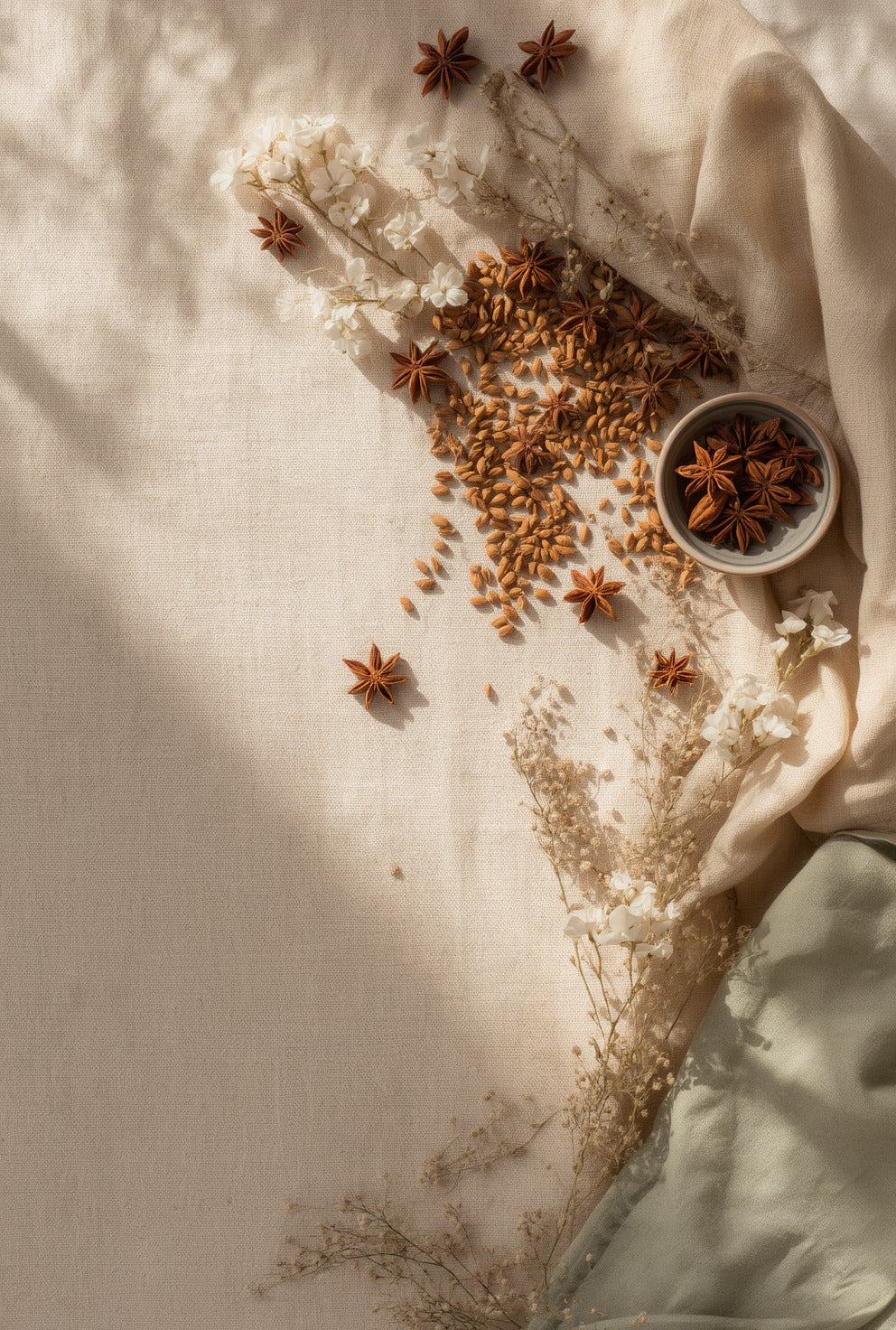
If you've ever spooned anise into a batch of biscotti or breathed in the warm, liquorice-sweet steam of a fennel-and-anise tea, you'll already know this little seed punches well above its weight. But is anise actually healthy, or is it just a pretty flavour with a good origin story?
As it turns out, it's both. Organic anise (Pimpinella anisum) has been a fixture in kitchens and herbal traditions for thousands of years — and modern food science is slowly catching up with what generations of cooks and healers already suspected. In this guide, we're unpacking the full picture: the nutrients inside every seed, the plant compounds responsible for its scent and its reputation, and the traditional uses that have made anise a quiet favourite among women in particular, from digestive comfort to hormonal transitions.
We'll keep things honest throughout — anise is a wonderful everyday ingredient, not a miracle cure, and we'll flag clearly where the science is solid and where it's still emerging.

What is anise?
Anise is a flowering herb in the Apiaceae family — the same botanical family as fennel, dill, parsley and coriander. Its small, ridged seeds are dried and used whole or ground as a spice, prized for their warm, sweet, liquorice-like flavour. That flavour comes almost entirely from one compound: anethole, which makes up the vast majority of anise's essential oil.
Anise is often confused with star anise, a completely unrelated spice from an evergreen tree native to China. The two simply happen to share the same dominant aroma compound, which is why they taste so similar despite coming from entirely different plants. We go into this — along with anise's full botanical story — in much more depth in Everything You Need to Know About Organic Anise.
The nutritional profile of anise seeds
Anise seeds are used in small quantities, so they're not going to replace a balanced diet — but weight for weight, they're a genuinely nutrient-dense little spice. Organic anise naturally contains:
- Dietary fibre — supports digestive regularity
- Iron — needed for healthy red blood cells and energy levels, particularly relevant for women managing monthly blood loss
- Calcium — for bone and teeth health
- Magnesium — involved in muscle function, energy production and nervous system regulation
- Manganese — supports metabolism and antioxidant defences
- Potassium — helps regulate fluid balance and healthy blood pressure
- Zinc — supports immune function and hormone regulation
- Natural antioxidants — including flavonoids and phenolic compounds
- Essential oils, dominated by anethole
Because anise is consumed in small, spice-level amounts (think a teaspoon, not a cupful), these nutrients are best thought of as a flavourful bonus on top of a varied diet, rather than a significant source on their own.
Anethole: the compound behind anise's reputation
Almost everything distinctive about anise — its scent, its flavour, and most of its researched effects — comes down to anethole, a naturally occurring aromatic compound that makes up around 80–95% of anise essential oil. The same compound is found in fennel and star anise, which is exactly why all three smell so similar.
Anethole is also the molecule behind anise's most talked-about (and most misunderstood) property: it has a chemical structure that allows it to interact, weakly, with oestrogen receptors in the body. This is what's known as phytoestrogenic activity — a plant compound that can loosely mimic the action of the hormone oestrogen. We'll explore exactly what this does and doesn't mean in the women's wellness and scientific insights sections below.
Anise as a source of antioxidants

Like many culinary herbs and spices, anise contains naturally occurring antioxidant compounds — primarily flavonoids and phenolic acids. Antioxidants help neutralise free radicals: unstable molecules produced naturally during everyday metabolism, and accelerated by stress, pollution and UV exposure. Over time, unchecked free radical activity contributes to oxidative stress, which researchers link to ageing and a range of chronic conditions.
No single spice is going to single-handedly fix your antioxidant status — that's a job for a varied, colourful diet overall. But regularly cooking with antioxidant-rich herbs and spices like anise is a simple, low-effort way to add to that picture, one meal at a time.
Digestive wellness: anise's oldest job
Long before anyone had isolated anethole in a lab, people across the Mediterranean, the Middle East and parts of Asia were finishing meals with a cup of anise tea — and for good reason. Anise has one of the longest-standing reputations of any culinary herb as a digestive aid, traditionally used to ease the sense of fullness and discomfort that can follow a heavy meal.
There's a plausible mechanism behind this folk wisdom: anethole has documented antispasmodic properties in laboratory research, meaning it may help relax smooth muscle, including the muscle lining the gut. This is consistent with why anise (alongside its cousin fennel) has been used for centuries to settle the stomach and ease bloating after eating.
Wellness tip: Brew a cup of warm anise tea after dinner. It's a genuinely lovely way to wind down an evening — caffeine-free, naturally sweet, and steeped in centuries of after-dinner tradition. For the full how-to, see our Complete Guide to Anise Tea.
Traditional uses throughout history
Anise isn't a trendy new "superfood" — it's one of the oldest spices in continuous use. It was already prized in Ancient Egypt, Greece and Rome more than 2,000 years ago, used in cooking, in early medicine, and even in the preservation of food. Pliny the Elder wrote about it; Roman bakers folded it into spiced cakes served at the end of feasts (the great-grandparent of the digestive biscuit, in a sense).
That long culinary-medicinal overlap is worth understanding: in most traditional systems, the line between "food" and "remedy" simply didn't exist the way it does today. A spice that tasted good and seemed to help you feel better after eating was valuable on both counts — which is exactly the role anise has played, in one form or another, for millennia.

Women's wellness: anise and hormonal change
This is the area people search for most — and the one most worth getting right, because it's also the area where myth and evidence get blurred together most easily.
Across Mediterranean and Middle Eastern herbal traditions specifically, anise has a long-standing reputation as a "woman's herb." It's been passed down through generations of home herbalists and used, in various forms, around menstruation, during breastfeeding, and through the menopausal transition. So where does that reputation actually come from?
It traces back to anethole's phytoestrogenic structure, mentioned above. Phytoestrogens are plant compounds that can weakly bind to the same receptors as the body's own oestrogen. In theory, this means anise could have a mild, hormone-modulating effect — and this is precisely why it has traditionally been reached for during phases of life marked by hormonal fluctuation: menstruation, the postpartum period, and the years around menopause, when oestrogen naturally declines and shifts.
Specific traditional associations include:
- Menstrual comfort — anise tea has traditionally been sipped to help ease the cramping and general discomfort some women experience around their period, often alongside other warming spices like fennel and cinnamon.
- The menopausal transition — in herbal traditions, anise (often alongside fennel) has been used during the years of hormonal fluctuation that come with perimenopause and menopause, valued for its warming, grounding qualities at a time of physical change.
- Breastfeeding — anise has a long folk history as a "galactagogue," a substance traditionally believed to support milk supply in nursing mothers, often taken as a mild tea.
What does the science actually say?
Here's where we want to be precise rather than persuasive. Laboratory and animal studies have shown that anethole does interact with oestrogen receptors and can produce measurable effects in those models — for example, research in mice has shown changes in reproductive tissue consistent with oestrogenic activity. Reviews collating decades of traditional and laboratory research have proposed several plausible mechanisms for anise's traditional role in "female disorders," including its antispasmodic effect on the uterus, its mild anti-inflammatory and analgesic properties, and its interaction with the hormone prolactin.
However, robust, large-scale human clinical trials are still limited. Much of the strongest mechanistic evidence comes from animal and laboratory studies, and at least one detailed scientific review explicitly notes that anethole's oestrogenic activity, while clearly demonstrated in lab settings, has not been firmly established as clinically meaningful in humans at typical dietary intakes. In plain terms: there's a credible, biologically plausible story for why anise earned its reputation — but "credible and plausible" is not the same as "clinically proven," and we think you deserve that distinction clearly stated.
It's also worth noting the flip side: because anethole behaves like a weak oestrogen, some research has flagged that very high intakes — far beyond normal culinary use — may affect hormone levels in ways that aren't desirable, particularly for anyone managing a hormone-sensitive condition. This is a useful reminder that "natural" and "more is better" are not the same thing.
Important: This information reflects traditional use and emerging research, not medical advice. Anise is not a treatment for menstrual, menopausal or lactation-related conditions. If you are pregnant, breastfeeding, managing a hormone-sensitive condition, or taking medication, speak with a healthcare professional before using anise beyond normal culinary amounts.
How different cultures have traditionally used anise
The "woman's herb" reputation isn't confined to one region — it shows up, in slightly different forms, right across the areas where anise has grown for centuries. In the Eastern Mediterranean and Levant, anise tea has traditionally been offered to new mothers in the weeks after birth. Across parts of the Middle East, aniseed-spiced biscuits and breads have long been associated with celebrations tied to motherhood and family milestones. In South Asian traditions, anise (often alongside fennel) appears in mukhwas — the spiced seed mixtures chewed after meals — and in postpartum care practices for new mothers. None of these are clinical protocols; they're cultural threads, repeated across generations and geographies, which is exactly why anise's reputation as a women's herb runs so deep and so wide.
Bringing this into your own routine, thoughtfully
If you'd like to explore anise as part of your own wellness routine, the simplest and lowest-risk approach is also the most traditional one: food-level amounts, used consistently, rather than concentrated extracts or supplements used intensively. A cup of anise tea in the evening, a teaspoon stirred into your porridge, or a pinch added to your cooking are all entirely reasonable ways to enjoy anise's traditional reputation without overreaching into territory the science doesn't yet support. If you're navigating a specific hormonal transition and considering anise more deliberately, it's worth a quick conversation with your GP, midwife or a qualified herbalist first — not because anise is dangerous in normal amounts, but because your specific circumstances deserve specific advice, not a blog post.
A note on moderation
It's worth repeating, because it's easy to lose in all the interesting detail above: anise is a food, used in food-level amounts, for thousands of years, by people who were not measuring anethole concentrations — they were just cooking and brewing tea sensibly. That's still the right approach today. A teaspoon of seeds, a cup or two of tea, a pinch in your baking: this is where anise's genuine, well-earned reputation lives. Concentrated extracts, essential oils taken internally, or "more is better" thinking sit outside that traditional, food-based pattern, and outside what this guide is recommending.
Supporting a healthy, balanced lifestyle
Beyond the more headline-grabbing topics above, anise earns a steady place in a health-conscious kitchen for a simpler reason: it makes food taste better without relying on sugar or salt.
Anise's naturally sweet, warm flavour means a pinch can round out a dish, a bake or a tea with very little — or no — added sugar. For anyone trying to gently reduce their sugar intake without giving up flavour, that's a genuinely useful everyday trick, not a gimmick.
It also fits naturally into the kind of varied, plant-forward, minimally processed way of eating that's consistently associated with good long-term health — not because anise itself is doing the heavy lifting, but because reaching for whole herbs and spices, rather than artificial flavourings, tends to go hand-in-hand with cooking from scratch more generally.
There's a broader point here too: spices like anise are part of why home cooking can feel genuinely satisfying rather than restrictive. A diet built around "don't eat this" rarely sticks. One built around discovering how a pinch of anise transforms roasted carrots, or how it turns an ordinary cup of tea into something that feels like a small ritual, tends to last a great deal longer — and that consistency, over months and years, is where most of the real benefit of "healthy eating" actually comes from.
Scientific insights: separating tradition from evidence
To bring this all together, here's the honest state of play on anise and health:
- Well established: Anise contains genuine nutrients (fibre, minerals, antioxidants) and a well-documented essential oil profile dominated by anethole.
- Reasonably well supported: Anise's traditional use as a digestive aid, linked to anethole's antispasmodic properties shown in laboratory research.
- Biologically plausible, still emerging in humans: Anise's traditional role in menstrual comfort, menopausal transitions and lactation support, linked to anethole's phytoestrogenic activity — clearly shown in animal and lab studies, but not yet firmly established through large human clinical trials.
- Worth respecting: Anise is a food, not a drug — wonderful in everyday culinary amounts, but not a substitute for medical care, especially around pregnancy, hormone-sensitive conditions or medication use.
We think that's a far more useful way to think about anise than either dismissing thousands of years of traditional use, or overselling it as a cure-all. It's a genuinely good spice, with a genuinely interesting story — and that's enough.
Frequently asked questions
Is anise healthy?
Used as a culinary spice, anise is a flavourful way to add fibre, minerals and antioxidants to your diet, and it carries a long traditional reputation for supporting digestion. Like any spice, it's best enjoyed as part of a varied, balanced diet rather than relied on alone.
What are the main benefits of anise seeds?
The most well-supported, traditionally recognised benefits are digestive comfort after meals and a naturally sweet flavour that can help reduce added sugar in recipes. Anise is also traditionally associated with women's hormonal wellness, though this area has more emerging than conclusive human research.
Does anise tea have health benefits?
Anise tea carries the same traditional digestive and aromatic benefits as the whole seed, in an easy, caffeine-free format. See our Complete Guide to Anise Tea for brewing methods and blends.
Can anise help with hormonal symptoms?
Anise has a long traditional use around menstruation, menopause and breastfeeding, linked to a plant compound (anethole) with phytoestrogenic properties. This effect is well documented in animal and lab studies but not yet firmly proven in humans. It should be seen as a traditional, food-based addition to your routine — not a treatment — and you should consult a healthcare professional for guidance specific to your situation.
Is it safe to eat anise every day?
Normal culinary amounts — a teaspoon or so of seeds, or a cup or two of tea — are considered a traditional part of daily life in many cultures. Very high intakes are not recommended, particularly for pregnant or breastfeeding women, or those with hormone-sensitive conditions. When in doubt, ask your doctor or pharmacist.
What's the difference between anise and star anise?
They're unrelated plants that happen to taste similar because they share the same dominant aromatic compound, anethole. Anise is a Mediterranean flowering herb; star anise comes from an evergreen tree native to Asia. We cover this fully in Everything You Need to Know About Organic Anise.
Can anise help with bloating?
Anise is traditionally used to ease the sense of fullness and discomfort after eating, and laboratory research has shown anethole has antispasmodic properties that may help relax gut muscle. This traditional digestive use is one of the better-supported benefits of anise, though individual results vary and persistent bloating is always worth discussing with a doctor.
Is organic anise better than non-organic anise?
Organic anise is grown without synthetic pesticides or artificial fertilisers, under certified standards that also tend to support soil health and biodiversity. Beyond the farming practice itself, many people find organic anise simply tastes fresher and more aromatic — a noticeable difference in a spice used specifically for its scent and flavour.
Bring organic anise into your kitchen
Now that you know the full story behind the seed, the easiest next step is the most enjoyable one: actually cooking with it. Browse our certified organic anise to start adding this quietly remarkable spice to your own kitchen.